





By Mohammad Talha, Trader | Reviewed for accuracy | Last updated: July 2026
The stock market for beginners can be summed up in one idea: when you buy a stock, you’re buying a small ownership stake in a real company, and its price moves based on how much other investors are willing to pay for that same stake at any given moment.
That sounds simple, and mechanically it is. What actually intimidates most beginners isn’t the concept — it’s the number of decisions that come with it: which broker, which account type, which investment, how much money to start with. This guide walks through all of it in the order you’ll actually need it.
How the Stock Market Actually Works
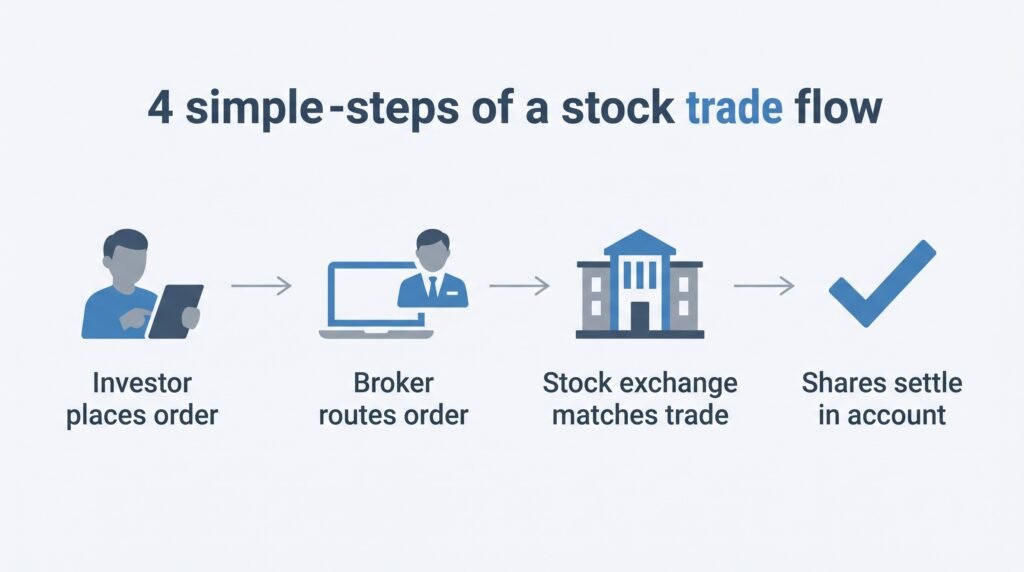
When a company wants to raise money to grow, it can sell shares of itself to the public through an Initial Public Offering (IPO). After that, those shares trade between investors on an exchange — in the US, mainly the New York Stock Exchange (NYSE) and the Nasdaq. You’re not buying from the company itself when you purchase a stock after its IPO; you’re buying from another investor who’s selling, and the exchange (through your broker) matches you up.
Prices move constantly because they reflect a live auction: if more people want to buy a stock than sell it at the current price, the price rises. If more people want to sell than buy, it falls. Company earnings, economic data, interest rate decisions, and plain sentiment all feed into that constant back-and-forth.
One thing worth internalizing early: a stock’s price on any given day tells you almost nothing about whether it’s a “good” company — it tells you what the market currently thinks it’s worth relative to buyers’ and sellers’ expectations. Confusing “the price went up” with “the company is doing well” is one of the fastest ways beginners get into trouble chasing momentum.
How Much Money Do You Need to Start Investing
You genuinely don’t need much. Most major US brokers now offer:
- $0 account minimums to open a brokerage account
- Fractional shares — meaning you can buy a $10 slice of a stock that trades at $300, instead of needing the full share price
- Commission-free trading on US stocks and ETFs at nearly every major broker
In practice, $50–$100 a month invested consistently into a broad index fund will build far more wealth over 10+ years than waiting until you have “enough” to feel ready. The habit matters more than the starting amount — this is the single most common regret experienced investors mention: not the trades that went wrong, but the years spent waiting on the sidelines for the “right” amount or the “right” moment.
How to Open a Brokerage Account (Step by Step)
- Choose a broker. Look at commission structure, available account types, and platform usability rather than chasing flashy features — for a beginner, a clean, simple interface beats a feature-heavy one you won’t use.
- Pick your account type. A standard taxable brokerage account is the simplest starting point. If you’re investing specifically for retirement, an IRA (covered below) has tax advantages worth understanding first.
- Provide your identification and personal details — Social Security number, employment info, and basic financial background (this is a regulatory requirement, not the broker being nosy).
- Fund the account via bank transfer — usually takes 1–3 business days to clear before you can invest it.
- Place your first trade. Most beginners overthink this step. Starting with a broad, diversified fund (like an S&P 500 index fund) rather than picking individual stocks removes most of the pressure from “getting it right” on day one.
Most of this process takes under 15 minutes online. The waiting period is almost always the bank transfer, not the account setup itself.
Stocks vs ETFs: What’s the Difference
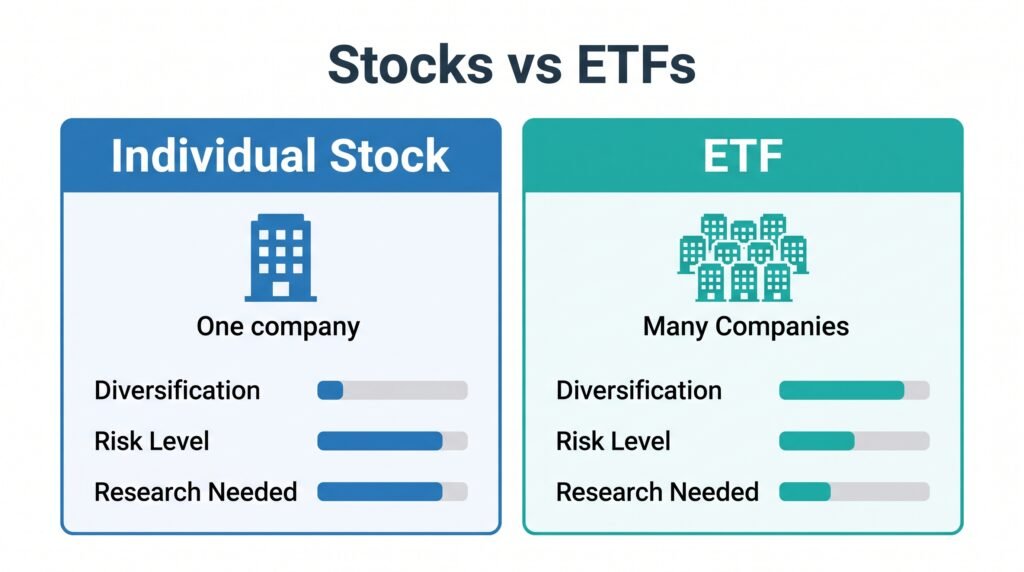
This is one of the first real decisions a beginner has to make, and it trips a lot of people up.
A stock is ownership in one single company. Buy shares of one company, and your investment’s fate is tied entirely to that one company’s performance.
An ETF (Exchange-Traded Fund) is a basket of many stocks (or other assets) bundled into a single tradable share. Buy one share of an S&P 500 ETF, for example, and you effectively own a small slice of 500 different companies at once.
| Individual Stock | ETF | |
|---|---|---|
| Diversification | None — single company | Built-in, across many companies |
| Risk | Higher (tied to one business) | Lower (spread across many) |
| Research required | Significant (you need to understand the specific business) | Minimal (the fund tracks an index or sector) |
| Typical use case | Investors with strong conviction in a specific company | Long-term, lower-effort wealth building |
| Fees | None to trade, no ongoing fee | Small annual expense ratio (often 0.03%–0.20% for broad index ETFs) |
The practical takeaway for beginners: ETFs are generally the more forgiving starting point, because a single company can go to zero — an index of 500 companies effectively never will. Most beginner-focused advice to “start with an index fund” comes down to this exact math, not conservatism for its own sake.
Smarter Ways to Start Investing as a Beginner
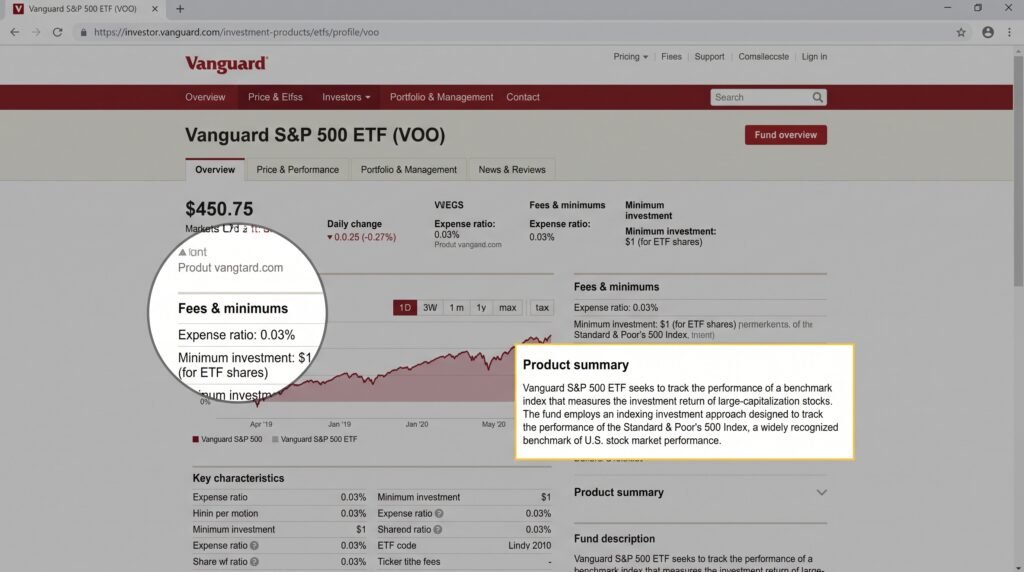
Rather than trying to pick the “best stock,” beginners are usually better served starting with:
- A broad market index fund (tracking the S&P 500 or total US stock market) — this gives instant diversification across hundreds of companies in one purchase
- Dividend-paying index funds or ETFs — for investors who want some of their return paid out as cash along the way rather than purely through price appreciation
- Target-date retirement funds — a single fund that automatically adjusts its stock/bond mix as you approach a chosen retirement year, useful for a completely hands-off approach
“Best Stocks to Buy in 2026” — Why This Question Needs a Different Answer
This is one of the most-searched phrases in investing, and it’s worth being direct about it: nobody — no article, no analyst, no algorithm — can reliably tell you in advance which individual stock will outperform this year. Anyone claiming otherwise is selling something.
What’s actually useful is a framework for evaluating a potential stock, rather than a list of tickers that will be outdated within months of publishing:
- Revenue and earnings trend — is the company growing its actual sales and profit, or just its stock price?
- Debt levels relative to cash flow — a company with strong sales but crushing debt is a different risk profile than sales growth funded by real cash generation
- Competitive position — does the business have something (brand, technology, network effect, cost advantage) that’s genuinely hard for a competitor to replicate?
- Valuation relative to growth — a great company at too high a price is still a bad trade; this is where most beginner mistakes actually happen, buying good businesses at prices that already assume years of perfect execution
If you want individual stock exposure, treat it as a smaller, deliberate slice of a portfolio built mainly around index funds — not the whole strategy.
Roth IRA vs Traditional IRA for Beginners
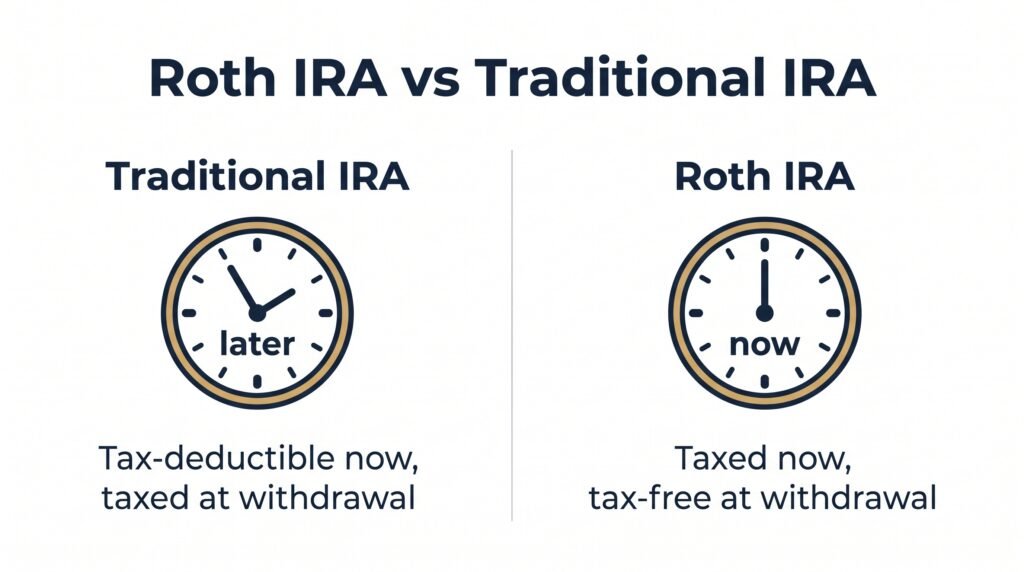
Both are retirement accounts with tax advantages, but the advantage lands at a different point in time:
- Traditional IRA — contributions may be tax-deductible now, and you pay taxes later when you withdraw in retirement. This tends to favor people who expect to be in a lower tax bracket in retirement than they are today.
- Roth IRA — contributions are made with money you’ve already paid tax on, but withdrawals in retirement (including all the growth) are completely tax-free. This tends to favor younger investors or anyone who expects to be in a similar or higher tax bracket later.
For most people starting out in their 20s or 30s with a lower current income, a Roth IRA is the more commonly recommended starting point — but this depends on individual circumstances, and it’s worth running your specific numbers or speaking with a tax professional before deciding, especially once income and contribution limits come into play.
AI Stock Trading Tools for Beginners
A newer category worth knowing about: AI-powered trading and analysis tools that scan market data, flag patterns, or generate trade ideas faster than manual research allows. These can genuinely speed up research — screening hundreds of stocks against criteria in seconds instead of hours — but they come with a real caution for beginners: an AI tool that outputs a confident-sounding recommendation is not the same thing as a reliable one. These tools are best used to narrow down a research list, not to replace your own understanding of what you’re buying and why.
Common Mistakes Beginners Make
- Trying to time the market — waiting for the “perfect” entry point usually costs more in missed growth than it saves in avoided dips
- Checking prices too often — daily price-checking on a long-term investment mostly just adds stress without adding information
- Going all-in on one stock early — concentration risk is the single fastest way a beginner’s account gets wiped out by one bad company-specific event
- Ignoring fees — a 1% annual fee difference sounds small but compounds into a meaningful chunk of returns over 20–30 years
- Investing money you’ll need soon — the stock market is not a place for money you might need in the next 1–3 years; short-term volatility can force you to sell at a loss right when you need the cash
Frequently Asked Questions
Is $100 enough to start investing in the stock market? Yes. With fractional shares and $0 minimums at most major brokers, $100 is enough to build a diversified starting position in an index fund. Consistency in adding to it matters far more than the size of the first deposit.
What’s the safest way for a beginner to invest in stocks? Broad market index funds or ETFs are generally considered the lower-risk entry point compared to individual stocks, because they spread your money across hundreds of companies instead of depending on one.
How long does it take to open a brokerage account? Account setup itself usually takes 10–15 minutes online. The main delay is the bank transfer to fund the account, which typically takes 1–3 business days.
Do I need a lot of money to open a Roth IRA? No — most brokers have no minimum to open a Roth IRA. The main constraint is the annual contribution limit set by the IRS, which changes periodically, so it’s worth checking the current year’s limit directly on IRS.gov.
Should a beginner buy individual stocks or ETFs first? Most financial educators recommend ETFs or index funds first, since they provide instant diversification. Individual stocks can be added later as a smaller, deliberate part of a portfolio once you’re comfortable researching specific companies.
Disclaimer: This article is for educational purposes only and does not constitute financial or investment advice. Investing involves risk, including the potential loss of principal. Always do your own research or consult a licensed financial advisor before making investment decisions.
Related reading: Candlestick Patterns: The Complete Guide | Best Day Trading Platforms for Beginners | Swing Trading Strategy Guide