







How Are Day Trading Profits Taxed? A Complete US Trader’s Guide
By Mohammad Talha, Trader | Reviewed for accuracy | Last updated: July 2026
Day trading profits are taxed as either short-term or long-term capital gains depending on how long you held each position, with most day trading activity falling into the short-term category — meaning it’s taxed at your regular income tax rate rather than the lower long-term capital gains rate. That single distinction (holding period) is the most important thing to understand before anything else in this guide, because it shapes almost every other tax decision a trader makes.
This is genuinely one of the more confusing parts of trading for beginners, mostly because the terminology (wash sales, cost basis, Form 8949) sounds more complicated than the underlying logic actually is. This guide breaks it down in plain terms — though for your specific situation, especially once real money and multiple account types are involved, this is exactly the kind of thing worth confirming with a CPA or tax professional rather than relying on any article alone.
Short-Term vs Long-Term Capital Gains: The Core Distinction
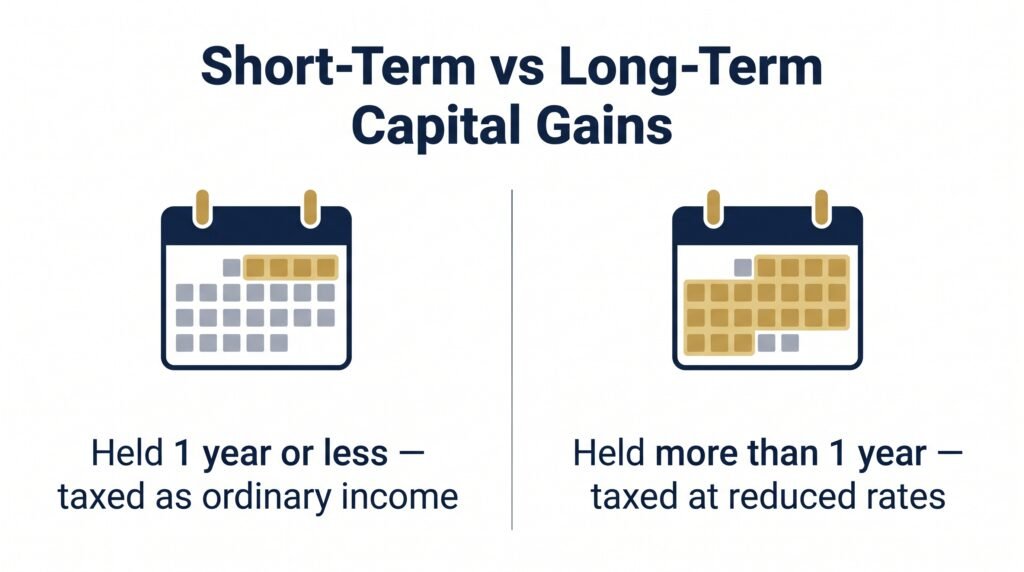
The IRS splits investment gains into two categories based purely on how long you held the position before selling:
- Short-term capital gains — from positions held one year or less. Taxed at your ordinary income tax rate, the same rate applied to your salary or other regular income.
- Long-term capital gains — from positions held more than one year. Taxed at reduced rates that are generally lower than ordinary income tax rates.
Since day trading by definition means opening and closing positions within the same day (or at most a few days for swing trades), nearly all day trading profit falls under short-term capital gains. This is one of the underappreciated trade-offs of active trading versus long-term investing: even if a day trader and a long-term investor made the identical dollar profit, the day trader likely owes more in taxes on that same profit, purely because of the holding period.
How Day Trading Profits Are Actually Calculated and Taxed
Each individual trade is treated as its own taxable event. For every position you close, the taxable gain or loss is calculated as:
Sale price − Cost basis (what you originally paid, including any fees) = Capital gain or loss
At the end of the year, all your short-term gains and losses get netted against each other first, then netted against any long-term gains and losses. The final net number is what actually gets taxed (or, if it’s a net loss, what can be deducted — covered below).
This netting process matters practically: a trader with ten winning trades and ten losing trades isn’t taxed on the ten wins in isolation — the losses offset the gains first, and tax is owed only on the net profit for the year.
The Wash Sale Rule Explained Simply
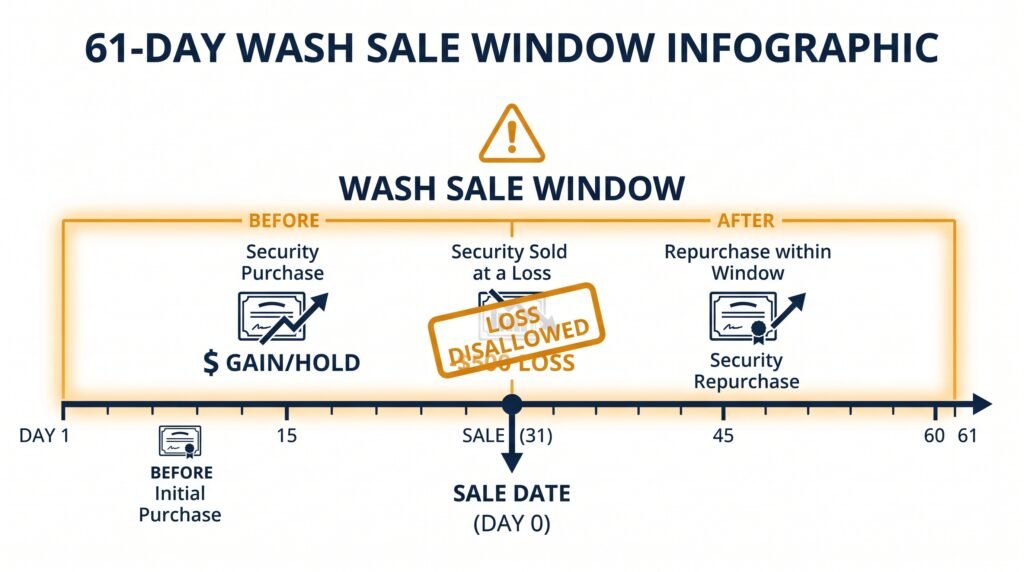
The wash sale rule exists to stop traders from selling a losing position purely to claim a tax deduction, then immediately buying the same (or a “substantially identical”) security back to keep their market position unchanged.
Here’s the simple version: if you sell a stock at a loss, and you buy the same stock (or something the IRS considers substantially identical, like certain options on the same stock) within 30 days before or after that sale, the loss is disallowed for tax purposes in that period. Instead, the disallowed loss gets added to the cost basis of the new position — it isn’t gone forever, but it is deferred rather than usable right away.
This trips up active traders more than any other rule on this list, because it’s easy to unintentionally trigger — buying back into a stock you still like the fundamentals of, shortly after taking a loss on it, is a completely natural trading instinct that happens to collide directly with this rule. Trading platforms and brokers typically flag wash sales on your 1099-B at year-end, but it’s worth understanding the mechanic yourself rather than only discovering it after the fact.
Do You Owe Taxes on Stock Losses? (Short answer: no — but there’s more to it)
You don’t owe tax on a loss itself — losses reduce your tax bill, they don’t add to it. Specifically:
- Capital losses first offset capital gains of the same type (short-term losses offset short-term gains, long-term offset long-term), then can offset the other type if there’s a remaining loss
- If your losses exceed your gains for the year, you can deduct a limited amount of the net loss against your ordinary income (the exact annual limit is set by the IRS and adjusts periodically, so check the current figure on IRS.gov rather than relying on a fixed number here)
- Any loss beyond that annual deduction limit isn’t wasted — it carries forward to future tax years, where it can offset future gains or be deducted again up to the same annual limit
This is actually one of the more trader-friendly parts of the tax code: a genuinely bad year doesn’t just cost you the trading loss, it also reduces your overall tax bill and can keep reducing future tax bills for years afterward until the loss is fully used up.
How to Report Stock Trades on Your Taxes
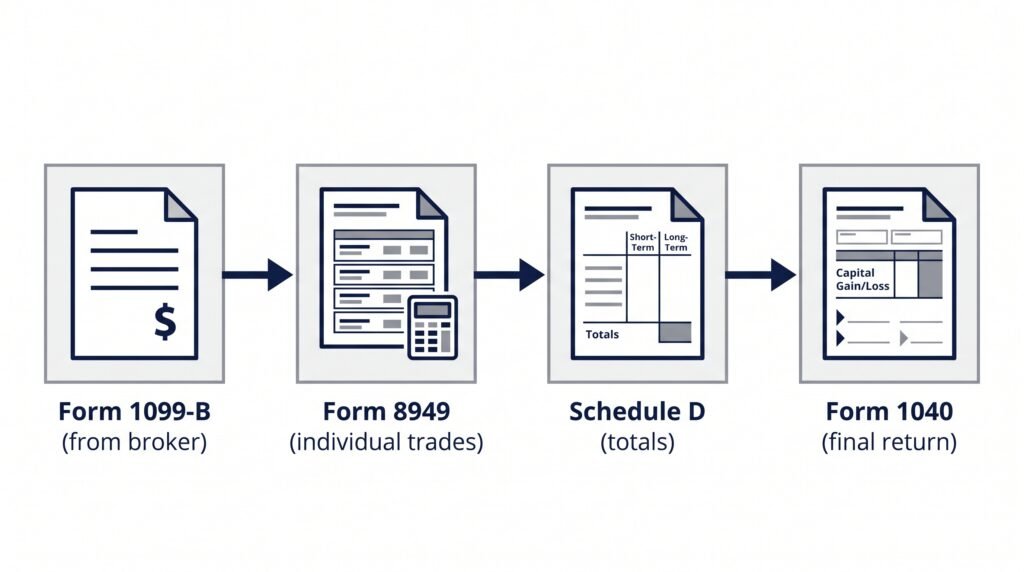
Most of this process is more automated than beginners expect:
- Form 1099-B — your broker sends this to you (and the IRS) after year-end, summarizing every sale, including proceeds and cost basis for most trades
- Form 8949 — this is where individual trades get listed, matching what’s on the 1099-B (many tax software programs import this directly from your broker, avoiding manual entry for each trade)
- Schedule D — this summarizes the totals from Form 8949, showing your net short-term and long-term capital gain or loss for the year
- Form 1040 — the final net capital gain or loss from Schedule D flows into your main tax return
For most retail traders using a standard brokerage account, tax software that imports directly from the broker handles the bulk of this correctly. Where it gets genuinely more complicated — and where professional help earns its cost — is high-frequency trading with hundreds or thousands of trades, multiple account types, or wash sale situations spanning different brokers.
Trader Tax Status (Mark-to-Market Election): For Very Active Traders Only
Traders who meet a high bar of trading frequency, volume, and consistency can potentially qualify for Trader Tax Status (TTS) with the IRS, which allows different treatment than a typical investor — including the ability to deduct trading-related business expenses and, with a mark-to-market election, treat gains and losses as ordinary income/loss rather than capital gains (which changes both the tax rate applied and removes the wash sale rule entirely for qualifying traders).
This status isn’t something you simply choose by checking a box — it requires meeting IRS criteria around trading as a substantial, regular, continuous activity, and the election process has specific deadlines. This is squarely “talk to a CPA who specializes in trader tax status” territory rather than a do-it-yourself decision, given how much it changes and how strict the qualifying criteria are.
State Taxes on Trading Income
Federal tax treatment is the same everywhere in the US, but state tax treatment varies significantly. Some states have no state income tax at all (which means no separate state tax on trading gains), while others tax capital gains as ordinary income at the state level on top of federal tax. Since this varies by where you live and can change with new state legislation, checking your specific state’s department of revenue site (or working with a CPA familiar with your state) is worth doing rather than assuming your state follows any particular pattern.
Common Tax Mistakes Traders Make
- Not tracking wash sales across multiple brokers — the rule applies across all your accounts, not just within one broker, and this is easy to miss if you trade the same stock in more than one place
- Assuming losses are simply “gone” instead of realizing they carry forward and keep providing value in future tax years
- Waiting until tax season to organize records instead of tracking cost basis and trade history throughout the year
- Assuming Trader Tax Status applies automatically just because someone trades frequently, without meeting the actual IRS criteria or filing the required election
- Ignoring state tax differences when relocating or when trading income becomes a meaningful part of overall income
Frequently Asked Questions
Do I have to pay taxes on day trading profits? Yes — day trading profits are taxable, generally as short-term capital gains taxed at your ordinary income tax rate, since most day trades are closed within a year (usually within the same day).
What is the wash sale rule in simple terms? If you sell a stock at a loss and buy the same or a substantially identical security back within 30 days before or after that sale, the loss is disallowed for that period and instead added to the cost basis of the new position, effectively deferring the deduction rather than eliminating it.
Do I owe taxes if I lost money trading? No — losses don’t create a tax bill. They offset gains first, and if losses exceed gains for the year, a limited amount can offset your ordinary income, with any remaining loss carrying forward to future years.
How do I report stock trades on my tax return? Your broker provides Form 1099-B summarizing your trades. Those figures get listed on Form 8949, summarized on Schedule D, and the net result flows into your Form 1040. Most tax software imports this directly from your broker.
What is Trader Tax Status? It’s an IRS classification for very active, frequent traders that can allow business expense deductions and, with a mark-to-market election, different (and potentially more favorable) tax treatment than standard capital gains rules — but it requires meeting specific IRS criteria and isn’t automatic.
Disclaimer: This article is for general educational purposes only and does not constitute tax, legal, or financial advice. Tax rules, rates, and thresholds change and can vary based on your individual circumstances and state of residence. Always consult a qualified CPA or tax professional and refer to current guidance on IRS.gov before making tax-related decisions.
Related reading: Best Day Trading Platforms for Beginners | Swing Trading Strategy Guide | Stock Market for Beginners