





Swing Trading Strategy: A Complete Guide for Beginners
By Mohammad Talha, Trader | Reviewed for accuracy | Last updated: July 2026
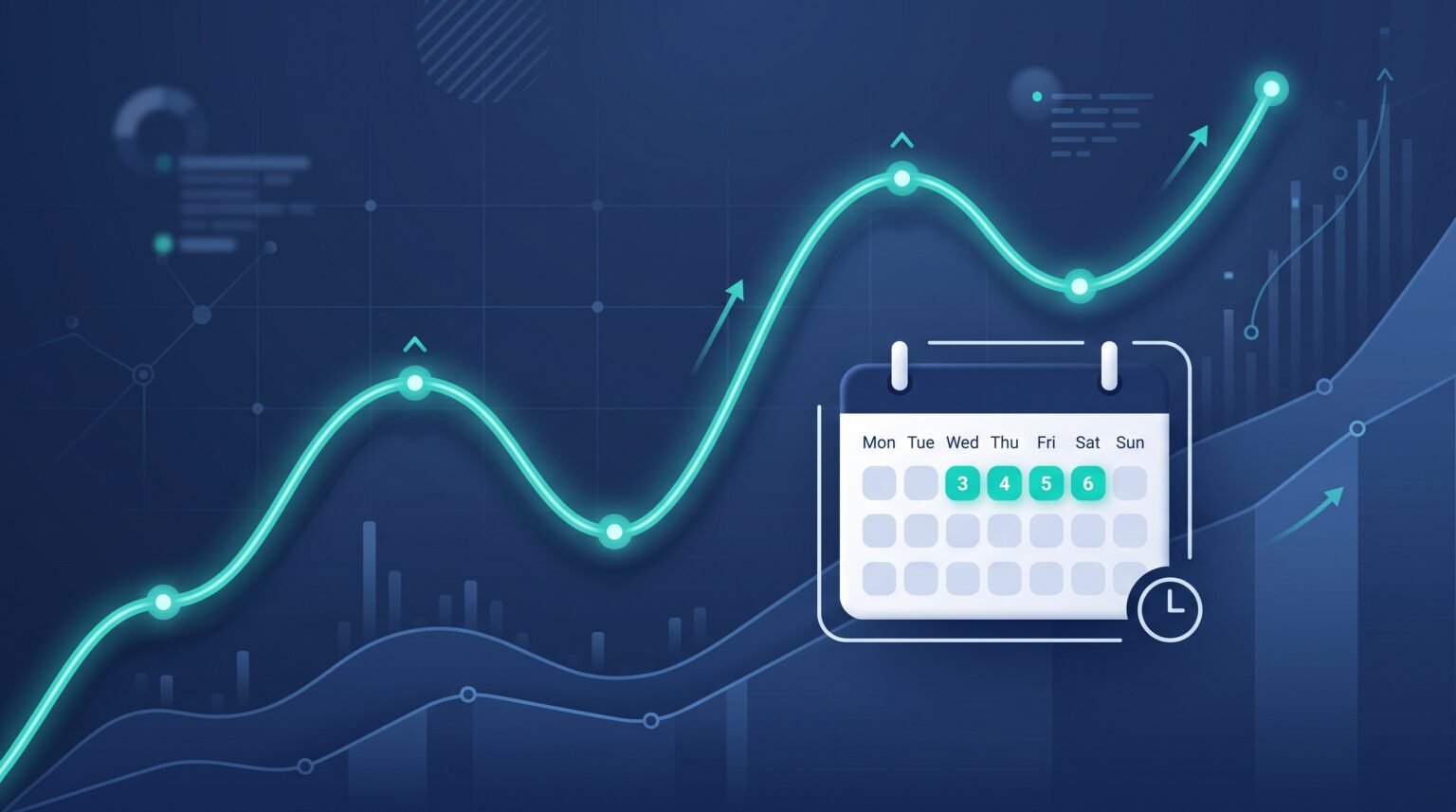
Swing trading means holding a position for anywhere from a few days to a few weeks, aiming to capture a price “swing” within a larger trend rather than the all-day moves a day trader chases or the years-long holds of a buy-and-hold investor. It sits deliberately in the middle ground — enough time for a real setup to play out, without needing to watch a screen every minute of the trading day.
That middle-ground nature is exactly why it’s a popular starting point for people with a full-time job or limited screen time: you can plan trades in the evening, check in once or twice a day, and still participate in meaningful price moves. This guide walks through an actual strategy framework, not just the definition.
Swing Trading vs Day Trading vs Long-Term Investing
- Day trading — positions opened and closed within the same day, sometimes within minutes. Requires constant screen attention and fast execution.
- Swing trading — positions held for days to a few weeks, based on technical setups within a broader trend. Requires daily or twice-daily check-ins, not constant monitoring.
- Long-term investing — positions held for months to years, based primarily on business fundamentals rather than short-term price patterns.
The practical difference that matters most for beginners: swing trading doesn’t require quitting your job or staring at charts all day, but it does require patience most day traders don’t have and more active management than a long-term investor needs.
The Core Swing Trading Framework
A workable swing trading approach comes down to four repeatable steps, applied consistently rather than reinvented for every trade.
1. Identify the Broader Trend First
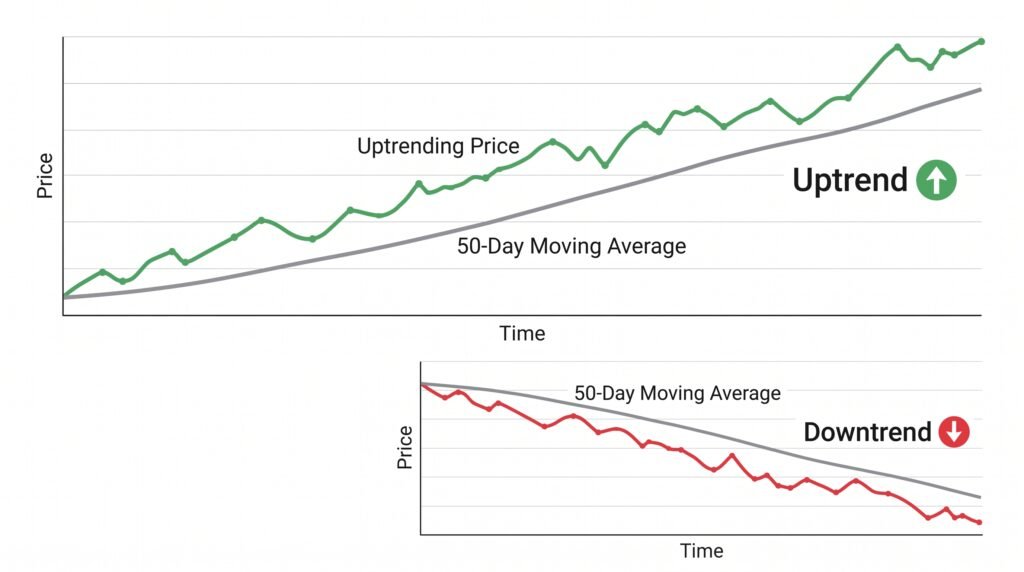
Swing trading works best with the dominant trend, not against it. Before looking for an entry, check the daily chart and ask a simple question: is this stock (or currency pair) in a clear uptrend, downtrend, or sideways range? A moving average — commonly the 50-day or 200-day — is a simple, reliable way to answer this: price consistently above a rising 50-day average suggests an uptrend; consistently below a falling one suggests a downtrend.
Trying to swing trade against a strong trend is one of the fastest ways new swing traders lose money — the setup might look technically correct on a smaller timeframe while the larger trend simply overwhelms it.
2. Wait for a Pullback, Not the Breakout
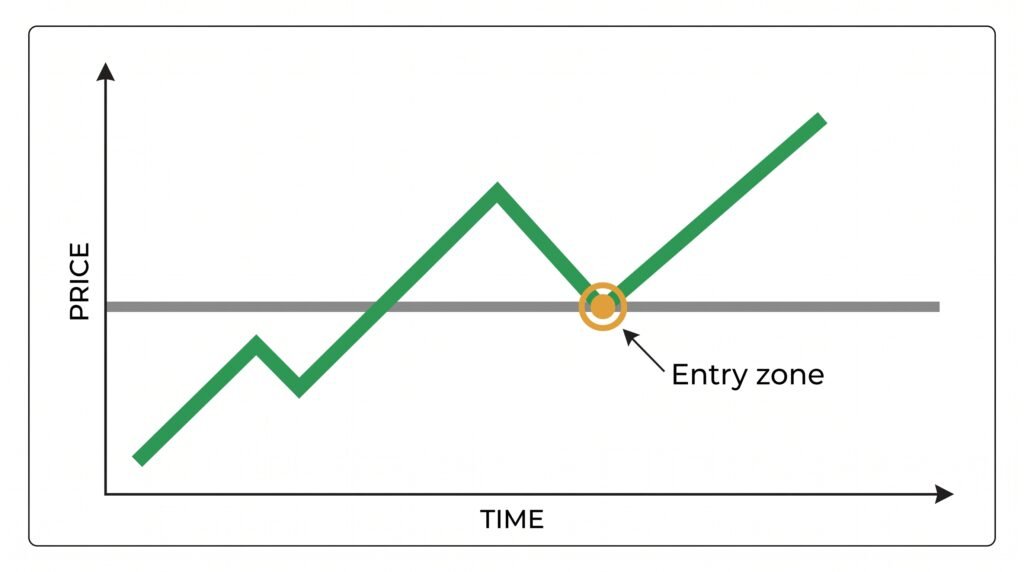
Counterintuitively, the best swing trading entries usually aren’t at fresh breakout highs — they’re at a pullback within an established trend. In an uptrend, that means waiting for price to retrace toward a support level (a prior swing low, a moving average, or a Fibonacci retracement zone) rather than chasing price after it’s already run up.
This is where the candlestick patterns covered in our candlestick patterns guide become directly useful: a bullish reversal signal (like a hammer or bullish engulfing candle) forming right at that pullback support level is a far stronger entry signal than the same pattern appearing in the middle of nowhere on the chart.
3. Define Entry, Stop Loss, and Target Before Entering
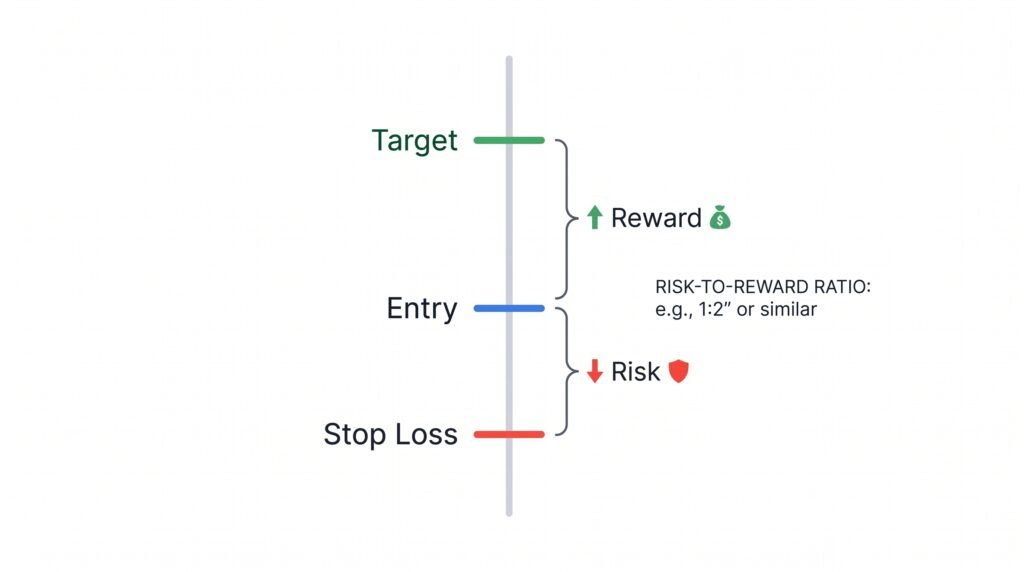
Every swing trade needs all three of these decided in advance, not figured out after the position is already open:
- Entry — the specific price or condition that triggers the trade (e.g., “close above yesterday’s high, following a bullish reversal candle at support”)
- Stop loss — the price where you’re proven wrong and exit to limit the loss, typically placed just beyond the recent swing low (for a long trade) with enough room to avoid normal daily noise
- Target — a realistic profit level based on the next resistance zone, prior high, or a fixed risk-to-reward ratio (many swing traders aim for at least 2:1 — risking $1 to make $2)
Deciding all three before entering removes the emotional decision-making that causes most beginners to hold losing trades too long and cut winning trades too short — exactly backwards from what actually builds an account over time.
4. Manage Position Size Based on Risk, Not Conviction
Position size should be calculated from your stop loss distance and how much of your account you’re willing to risk on one trade — not from how confident you feel about the setup. A common starting guideline is risking no more than 1–2% of total account value on any single trade. That means the position size itself is a math problem (account risk ÷ distance to stop loss), not a gut feeling, and it’s the single biggest factor separating traders who survive a string of losing trades from those who don’t.
Swing Trading Indicators Worth Knowing
You don’t need a cluttered chart with 15 indicators. A focused swing trading setup usually relies on a small handful used consistently:
- Moving averages (50-day, 200-day) — for identifying the broader trend direction
- RSI (Relative Strength Index) — for spotting when a pullback has pushed a stock into oversold territory within an uptrend (or overbought within a downtrend), often a useful timing confirmation
- Support and resistance levels — prior swing highs/lows that price has respected before
- Volume — a pullback on light volume followed by a reversal on heavier volume adds real confidence to an entry signal
Adding more indicators past this point tends to create conflicting signals rather than better decisions — a common trap for beginners who assume more tools automatically means more precision.
Forex Swing Trading Strategies: What’s Different

The same core framework applies to forex, with a few adjustments worth knowing:
- 24-hour market — unlike stocks, forex trades nearly around the clock on weekdays, which means overnight gaps are less common but news-driven moves can happen at any hour
- Trend identification matters even more — currency pairs often trend for longer, cleaner stretches than individual stocks, making the “trade with the trend” principle especially important
- Economic calendar awareness — interest rate decisions, employment data, and central bank statements can move currency pairs sharply; checking a economic calendar for scheduled releases before holding a swing position through them is a habit serious forex swing traders build early
- Leverage requires extra caution — forex brokers often offer much higher leverage than stock brokers, which magnifies both gains and losses; the 1–2% risk-per-trade rule matters even more here, not less
Common Mistakes in Swing Trading
- Ignoring the broader trend and trading purely off a short-term pattern that looks good in isolation
- Chasing breakouts instead of waiting for a pullback entry with a tighter, more logical stop loss
- Moving the stop loss further away once a trade starts going against expectations, instead of accepting the original plan
- Oversizing positions based on excitement about a setup rather than calculated risk
- Holding through major news events without accounting for the added volatility risk
- Overtrading — taking marginal setups just to stay active, instead of waiting for the setups that actually meet the full framework
Frequently Asked Questions
How long do swing trades typically last? Most swing trades are held anywhere from a few days to a few weeks, depending on how quickly the price move plays out. Some resolve in 2–3 days; others take several weeks to reach a target or stop.
Is swing trading good for beginners? Swing trading is often considered more approachable for beginners than day trading, since it doesn’t require constant screen time or split-second decisions, while still being active enough to build real trading experience faster than long-term investing alone.
What’s the best timeframe for swing trading? Most swing traders make trend and setup decisions on the daily chart, then may use a 4-hour or 1-hour chart to fine-tune entry timing. Relying only on very short timeframes tends to generate more false signals.
How much money do I need to start swing trading? There’s no strict minimum, though having enough capital to properly size positions according to a 1–2% risk-per-trade rule matters more than a specific dollar amount. Starting with a few thousand dollars gives more flexibility than a very small account, where position sizing becomes overly restrictive.
Does swing trading work in forex as well as stocks? Yes, the same core framework (trend identification, pullback entries, defined risk) applies to forex, with added attention to economic calendar events and more careful leverage management given how much higher leverage is typically available in forex accounts.
Disclaimer: This article is for educational purposes only and does not constitute financial or investment advice. Trading involves substantial risk, including the potential loss of principal, and leverage (especially in forex) can amplify losses. Always do your own research or consult a licensed financial advisor before making trading decisions.
Related reading: Candlestick Patterns: The Complete Guide | Stock Market for Beginners | Best Day Trading Platforms for Beginners